

You’re in the chair, the basic dental examination is done, and your dentist says you need a dental X-ray. Your teeth feel fine. Nothing hurts. So why does someone need to take a picture of something that clearly isn’t a problem?
It’s one of the most common pushbacks we get in dentistry, and it’s not an unreasonable one. If your mouth isn’t sending you any distress signals, an extra step (and often an extra cost) can feel unnecessary. The honest answer is that pain is one of the last symptoms to show up in dentistry, not the first. By the time something hurts, it’s usually already been developing quietly for a while.
What your dentist can and can’t see without an X-ray
A clinical exam tells us a lot. We can see the surfaces of your teeth, spot visible staining, check your bite, and examine your gums. What we can’t see through is enamel, bone, or an old filling.
That’s the entire point of a dental X-ray. It shows what’s happening beneath the surface and between teeth, the parts of your mouth that a dental mirror and a dental light simply can’t reach. Without one, a dentist could easily miss:
- A cavity forming in the tight space between two teeth
- Decay creeping in underneath an existing filling
- An infection sitting quietly at the root of a tooth
- Bone loss caused by gum disease, long before a tooth starts to feel loose
- Wisdom teeth that are impacted or growing at an angle
- Cysts or other changes forming inside the jaw
For your information, none of these has to hurt to be there. That’s what makes them worth catching early rather than waiting for a symptom.
Why this matters even more in Kenya
Oral health data from Kenya make a stronger case for X-rays than most global averages do. The country’s first (and so far only) National Oral Health Survey, conducted in 2015, found that nearly half of five-year-olds already had dental caries, and gum inflammation showed up in almost the entire sample of children examined. A more recent Ministry of Health oral health assessment put untreated dental caries in over half of Kenyans, with gum disease present in more than 90% of the population surveyed.
WHO’s Africa regional data adds more context. It stated that Kenya has one of the highest rates of early childhood tooth decay on the continent. And in areas with naturally high fluoride levels in groundwater, something common in several Kenyan regions, dental fluorosis affects a significant share of children, a condition that’s often invisible until it’s advanced enough to change the appearance of the teeth.
The pattern across almost all of this research is the same: oral disease in Kenya tends to be widespread, largely untreated, and often silent until it isn’t. That’s exactly the gap an X-ray is designed to close.
Is a dental X-ray actually safe?
This is usually the second question, right after “why do I need one?” Fair, nobody wants unnecessary radiation exposure.
Here’s what the numbers actually look like. A single dental bitewing X-ray delivers roughly 5 microsieverts of radiation. For comparison, a chest X-ray is around 10 microsieverts, and a long-haul flight exposes you to background radiation in a similar range from natural atmospheric sources. Dental imaging as a category makes up less than 1% of the total radiation people receive from medical imaging overall, according to the American Dental Association.
Digital X-rays, which are what modern clinics, including ours, use, cut that exposure further, up to 50% lower than older film-based systems, alongside a lead apron and thyroid shield as standard practice. The ADA and FDA’s updated 2024 guidance is built around one core principle: only take an X-ray when there’s a clinical reason to, and always use the lowest dose that still produces a clear image. Guesswork and routine imaging “just in case” aren’t the standard; professional clinical judgment is. So, you can trust our dental surgeon’s advice whenever you visit.
So how often do you actually need one?
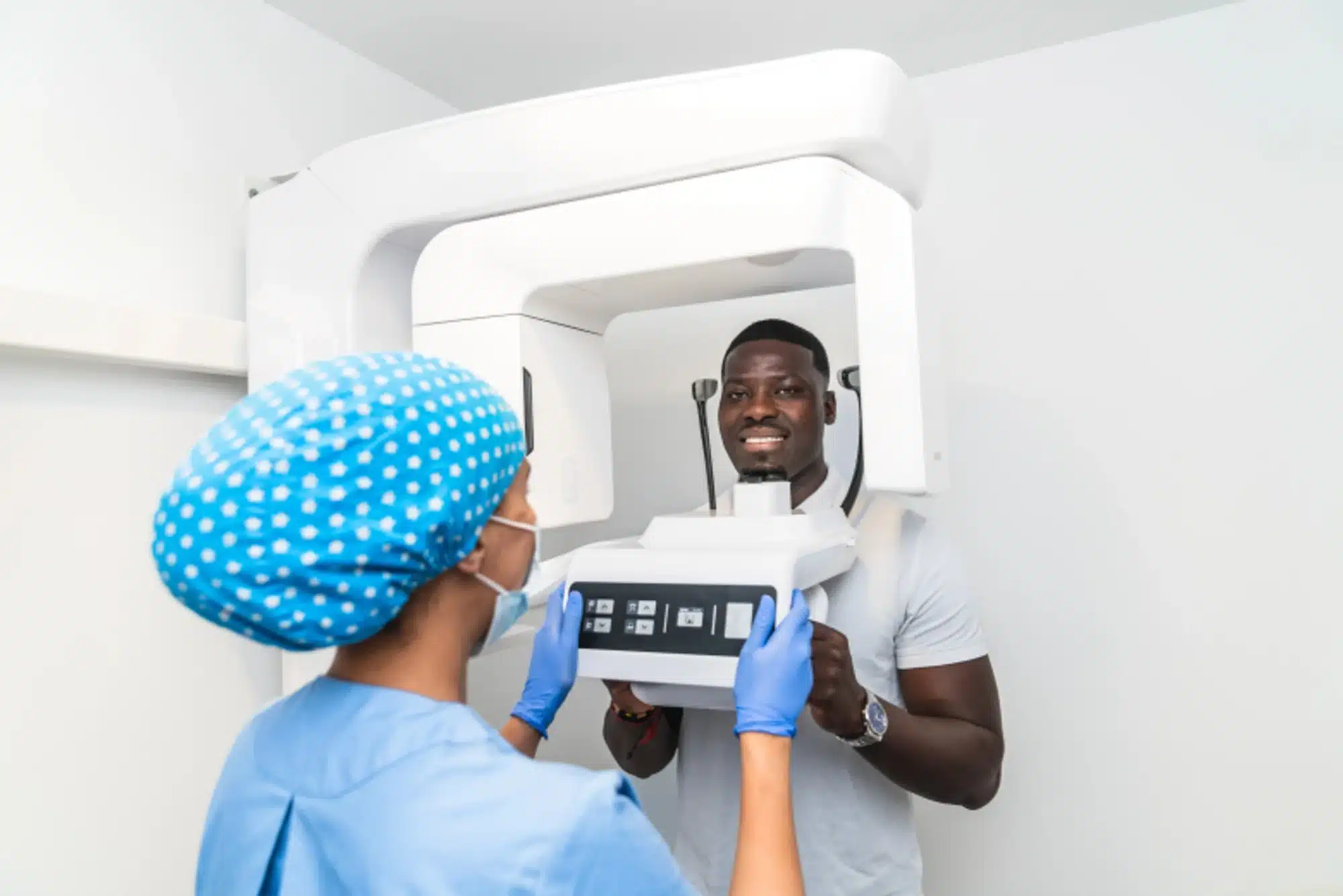
There’s no universal answer. The ADA’s general guidance suggests imaging intervals anywhere from six months to three years, depending on your individual risk factors; that is, your caries history, gum health, age, and whether you’ve had previous dental work that needs monitoring.
A teenager with a history of cavities and a healthy 45-year-old with no dental issues in a decade don’t need the same imaging schedule. This is meant to be tailored to you, not applied as a blanket studio policy.
What happens if you keep skipping it
The risk with avoiding dental X-rays isn’t that something goes wrong immediately. The compounded outcome is that problems are given more time to grow before anyone catches them. A small cavity between two teeth, caught early, is a straightforward filling. Left undetected for a year or two, it can progress into an infection that needs a root canal or, eventually, an extraction. Bone loss from gum disease follows a similar pattern. It’s often symptom-free until a tooth is already at risk.
In a market where dental costs matter and treatment decisions are made carefully, early detection isn’t a luxury add-on. It’s usually the more affordable and less invasive path, simply because it catches problems when they’re still small.
What to expect at Tender Care Dental
At our Lavington clinic, we don’t recommend dental X-rays as a routine upsell; we use digital imaging with reduced radiation exposure, and we’ll always explain exactly what we’re looking for and why, based on your specific history and exam findings. If nothing warrants one, we’ll say so.
If it’s been a while since your last check-up, you need a second opinion, or you’ve never had one done, it’s worth having a conversation with your dentist about whether you’re due.
Book your check-up and consultation at Tender Care Dental, Lavington. We’ll walk you through what your mouth actually needs.


